
Table of Contents
As 2026 approaches, employers across Washington—especially those in the 25–49 employee range—are entering one of the most significant compliance shifts in recent years. Federal FMLA and Washington’s job protection landscape have expanded in ways that will directly affect how Puget Sound businesses manage leave, job reinstatement, and risk. At Fully Integrated Team (FIT) HR, we work closely with organizations across Seattle, Tacoma, Bellevue, Everett, and the broader Puget Sound region to help them navigate these changes with clarity and confidence.
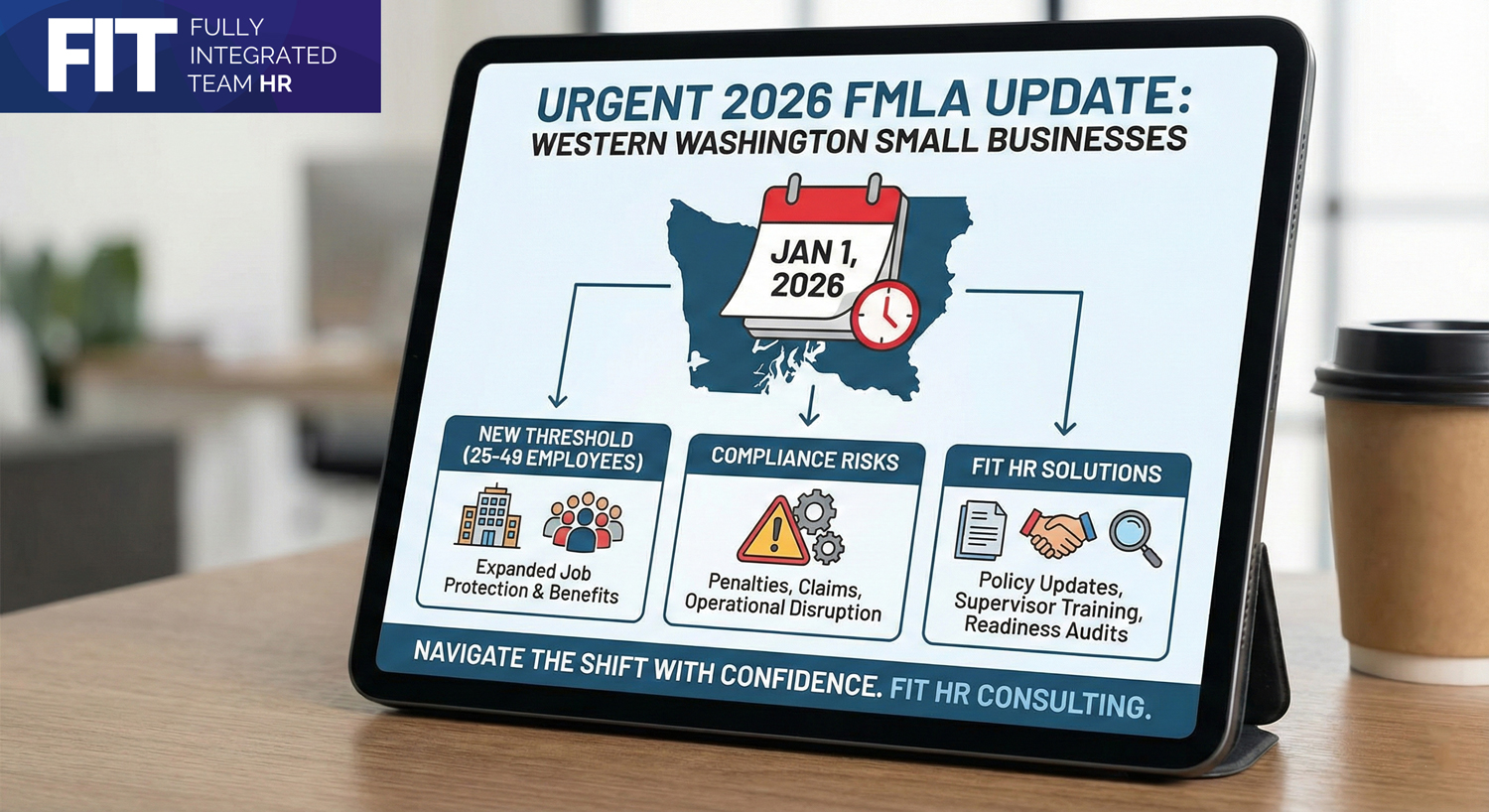
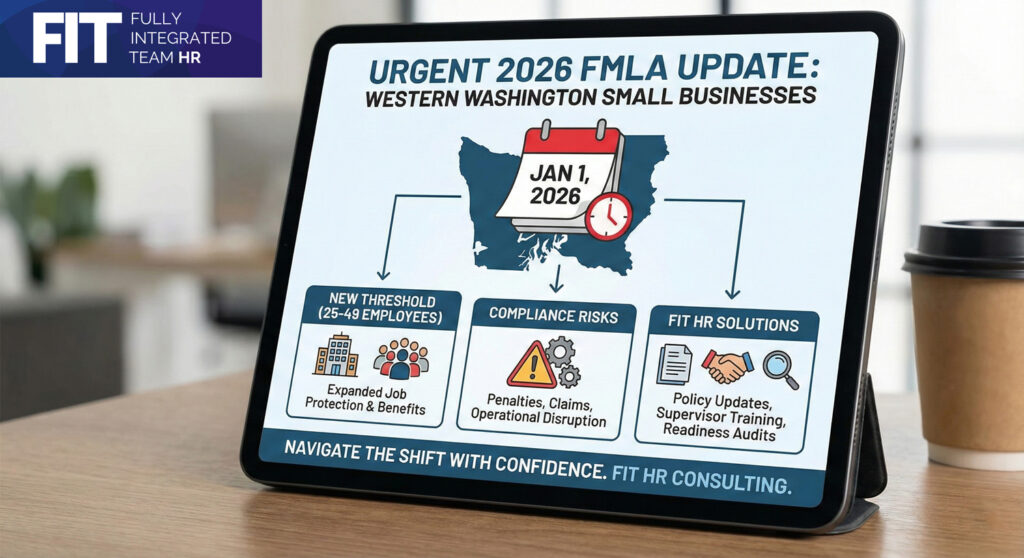
On January 1, 2026, that assumption ends. New state-level job protection rules now extend coverage to employers with 25–49 employees, meaning thousands of Washington small businesses must immediately adjust policies, procedures, and supervisor training.
As consultants specializing in Washington State PFML, leave management, and crisis-level compliance, we’ve already begun partnering with local organizations who want to avoid costly missteps. FIT HR has seen firsthand how quickly incorrect leave decisions can escalate—penalties, employee claims, operational disruptions, and reputational harm are common when employers try to manage these rules on their own.
How the Washington Job Protection Changes Affect Small Businesses
Washington’s expanding job protection rules align more closely with federal FMLA but place new obligations on employers below the traditional FMLA 50-employee threshold. This includes businesses across Maple Valley, Kent, Auburn, Renton, Issaquah, Kirkland, and throughout the state.
Here’s what changes occur under WA PFML starting January 1, 2026:
1. Employers with 25–49 employees must now provide job-protected leave
This means you must:
- Hold the employee’s position or an equivalent role during leave
- Maintain health benefits during approved leave
- Restore employment without retaliation or interference
This removes the previous “small business exemption” that many employers relied on.
2. Leave coordination becomes mandatory
Washington Paid Family and Medical Leave (PFML) does not replace FMLA.
This complexity creates significant risk if managers or HR teams are not trained. Missteps include:
- Failing to follow proper notification process
- Failing provide job protection or restoration to eligible employees.
- Misidentifying a qualifying medical event
- Failing to track intermittent leave properly
3. Medical documentation review processes must be tightened
Under the new rules, clearer timelines and employer responsibilities apply. Businesses must be adopted:
- Standardized medical certification procedures
- Consistent follow-up practices
- Strong documentation systems
4. Supervisor errors now carry higher legal consequences
Front-line managers make most leave-related mistakes—not because they intend to, but because they lack training. With expanded job protection, wrongful terminations and misclassification errors will be easier for employees to challenge.
At FIT HR, we strongly recommend that small businesses schedule 2026 manager training now, not later. Supervisors should not be diagnosing, interpreting medical certifications, or approving/denying leave on their own.
Why These Changes Matter for Washington Employers
The shift in job protection rules is landing at a time when Puget Sound small businesses already face talent shortages, rising labor costs, and increasing expectations around employee support. Mistakes with Washington State PFML coordination can trigger:
- Employee claims
- Wage reimbursement issues
- ADA accommodation conflicts
- Retaliation allegations
- Wrongful termination lawsuits
- Penalties for interfering with leave rights
The Washington Employment Security Department has increased its enforcement capabilities, and employee awareness is at an all-time high due in part to state education campaigns (Washington Paid Family & Medical Leave Program).
For employers who want stability through these changes, it’s essential to have clear policy language, strong documentation practices, and guidance from experienced HR consultants who manage these risk areas daily.
How FIT HR Supports Small Businesses Through 2026 PFML Compliance

FIT HR is a local Washington firm rooted in integrity, consistency, and competence. Our team supports small and mid-sized employers across the entire Puget Sound region through both short-term consulting and long-term HR leadership partnerships.
Clients often come to us because they want something the national providers don’t offer—real partnership from an HR professional who knows Washington laws, business rhythms, and industries.
Below are core services we provide to help employers adjust to the 2026 rules.
1. Complete Leave Management Policy Reviews
With new job protection requirements, many businesses need their entire leave section rewritten. FIT HR updates policies to include:
- Washington State PFML compliance
- ADA interplay
- Intermittent leave processes
- Return-to-work guidelines
- Health benefit continuation rules
2. Supervisor Training for 2026Compliance
Managers need exact scripts, boundaries, and action steps so they do not unintentionally violate state or federal rules.
FIT HR trains supervisors in:
- Understanding qualifying leave events
- Handling medical documentation
- Responding appropriately to employee disclosures
- Properly designating leave
- Avoiding retaliation or interference
- Communicating job restoration requirements
3. Leave Case Management and Crisis Support
Many of our clients rely on FIT HR to manage complex cases from start to finish—especially when a leave overlaps with performance issues, conduct concerns, ADA requests, or workers’ compensation claims.
As noted on our Crisis Management page, FIT HR helps employers stabilize high-risk situations before they escalate.
4. Fractional HR Leadershipfor Organizations Who Need Ongoing Support
For employers in the 25–49 range, 2026 may be the year when the business outgrows an office manager or part-time HR assistant handling compliance. Fractional HR leadership provides expert-level support without the cost of hiring a full-time HR director.
5. 2026 Readiness Audits for Puget Sound Businesses
FIT HR conducts audits that examine:
- Current leave policies
- Documentation procedures
- Manager communication methods
- Alignment with federal FMLA
- Alignment with PFML
- ADA accommodation conflicts
- Benefit continuation processes
- Termination or discipline risks
These audits are especially valuable for construction organizations, healthcare clinics, property management groups, hospitality businesses, and professional service firms—sectors where intermittent leave and job protection decisions are common.
Key Compliance Steps Washington Small Businesses Should Complete Before January 1, 2026
To avoid legal and operational risk, FIT HR recommends completing these steps now:
1. Update the employee handbook with correct 2026 language
Include WA PFML eligibility for 25–49 employees, job protection requirements, and Washington-specific leave coordination.
2. Train supervisors and leads
Most legal risk stems from miscommunication, retaliation claims, and improper documentation. Training is essential.
3. Create standardized processes for medical documentation
This includes certification forms, follow-up timelines, communication templates, and internal tracking procedures.
4. Clarify ADA and PFML interaction
Federal and state rules overlap, and ADA obligations extend beyond leave. Every business should adopt a process to handle situations involving extended or modified duty.
5. Establish a return-to-work procedure
This protects both the employee and the employer. Improper reinstatement decisions have become a major source of claims nationwide (U.S. Department of Labor FMLA Employer Guide)
6. Audit job descriptions for accuracy
Essential functions must be clearly defined before you evaluate leave eligibility, modified duty, or reinstatement requirements.
Why FIT HR Is the Partner Washington Employers Trust

As a local team serving Washington businesses, FIT HR understands the realities that owners and managers face—tight staffing, evolving state laws, and the pressure to balance employee support with operational continuity. Our approach is rooted in:
- Compliance expertise
- Calm, clear communication
- Real-time guidance during complex cases
- Tailored solutions for your industry and workforce
- A true partnership mindset
We don’t provide generic templates or national call-center advice. Employers choose FIT HR because they want thoughtful, experienced professionals who understand the unique landscape of the Puget Sound business community.
With the shift in Washington State PFML rules, small businesses cannot afford uncertainty or guesswork. FIT HR is ready to guide organizations through every step of the transition, so they maintain compliance, protect their teams, and continue operating with stability.
Ready to Prepare for the 2026 WA PFML Rules?
FIT HR is currently scheduling 2026 compliance assessments, supervisor training, and handbook updates for Washington organizations.
If your business employs 25–49 people, the new rules apply to you—and we are here to help you navigate them smoothly and confidently.